> ## Documentation Index
> Fetch the complete documentation index at: https://docs.getimpala.ai/llms.txt
> Use this file to discover all available pages before exploring further.
# Run async and open source
> Cheaper inference, better quality. The best open-source models cost far less to run when your workload can tolerate latency.
Open-weight models are at the frontier, so **spending less no longer means running something weaker**. What costs money is the volume of tokens you push through them — and most of that volume runs with nobody watching: coding agents grinding through a repo overnight, research agents that take four minutes to come back with an answer, nightly jobs classifying a few million records. The deadline applies to the finished task, so paying interactive prices for a fast first token buys you nothing.
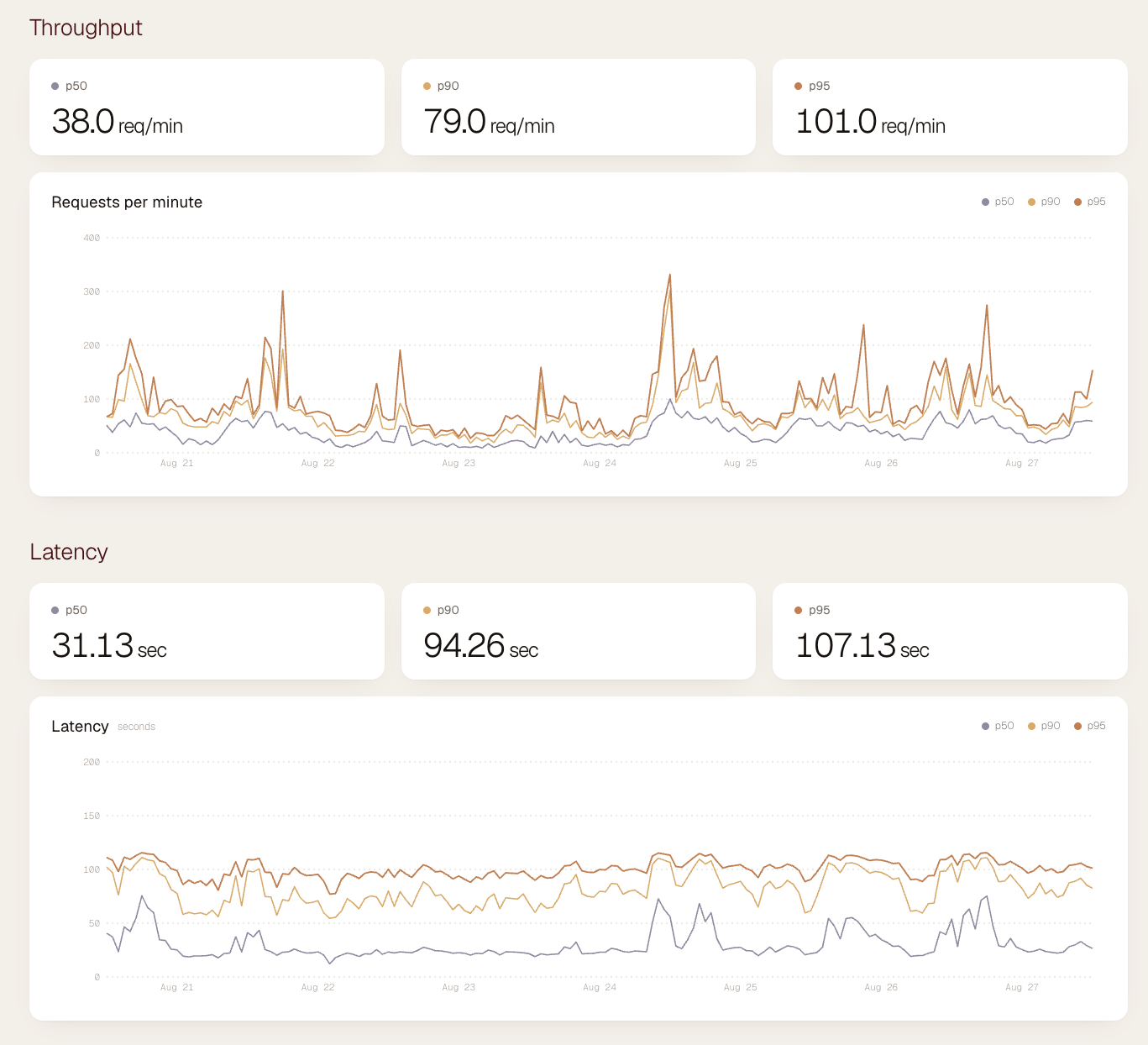
That is the traffic Impala is built for: **async inference**, meaning model calls where no human reads the tokens as they arrive. Latency you aren't using is the one thing you can trade for a much lower price on the same model — cheap enough that you stop rationing turns and context.
| | Interactive | Async |
| ------------------ | ------------------------ | -------------------------------------- |
| Immediate response | Expected, token by token | Not required |
| Measured by | TTFT, TPOT, ITL | Tasks per dollar, task completion time |
| Capacity is | Held ready | Kept busy |
## The metric is tasks per dollar
For async work the question is: for a fixed budget, how many tasks finish? That's **tasks per dollar** — the cost of one completed task. Two numbers feed it: **throughput**, how many tokens the fleet produces, and **task completion time**, how long one task takes end to end.
Throughput and task completion time aren't a trade against each other: **faster and cheaper, not faster or cheaper**. A single request may sit longer here than at an interactive provider, while the task it belongs to finishes sooner and costs less — because the scheduler works the whole trace rather than each call in isolation. A GPU costs the same per hour saturated or idle, so cost per token is a throughput problem: double throughput on the same hardware and cost falls by roughly half. The argument with the numbers is in [Run It Hot](https://www.getimpala.ai/blog/run-it-hot); the engine that delivers it is [Impala Herd](/impala-herd).